
AI vs Automation: What's the Difference?
Understanding the difference between artificial intelligence and automation — and why modern businesses need both.
Artificial intelligence and automation are wo of the most discussed technologies in modern business. They are also two of the most misunderstood.
In conversations surrounding digital transformation, operational efficiency, and modern workflows, "AI" has increasingly become a catch-all term used to describe nearly any form of technological improvement. Automation, integrations, intelligent systems, and workflow tools are often grouped together under a single label despite functioning very differently behind the scenes.
But AI and automation are not the same thing.
Understanding that distinction starts with understanding what AI actually means in a modern business environment.
They solve different categories of operational problems, create value in different ways, and play different roles within modern business systems. Understanding that distinction matters because businesses that misunderstand the difference often pursue the wrong solutions, implement technology in the wrong areas, or expect outcomes that the underlying systems were never designed to produce.
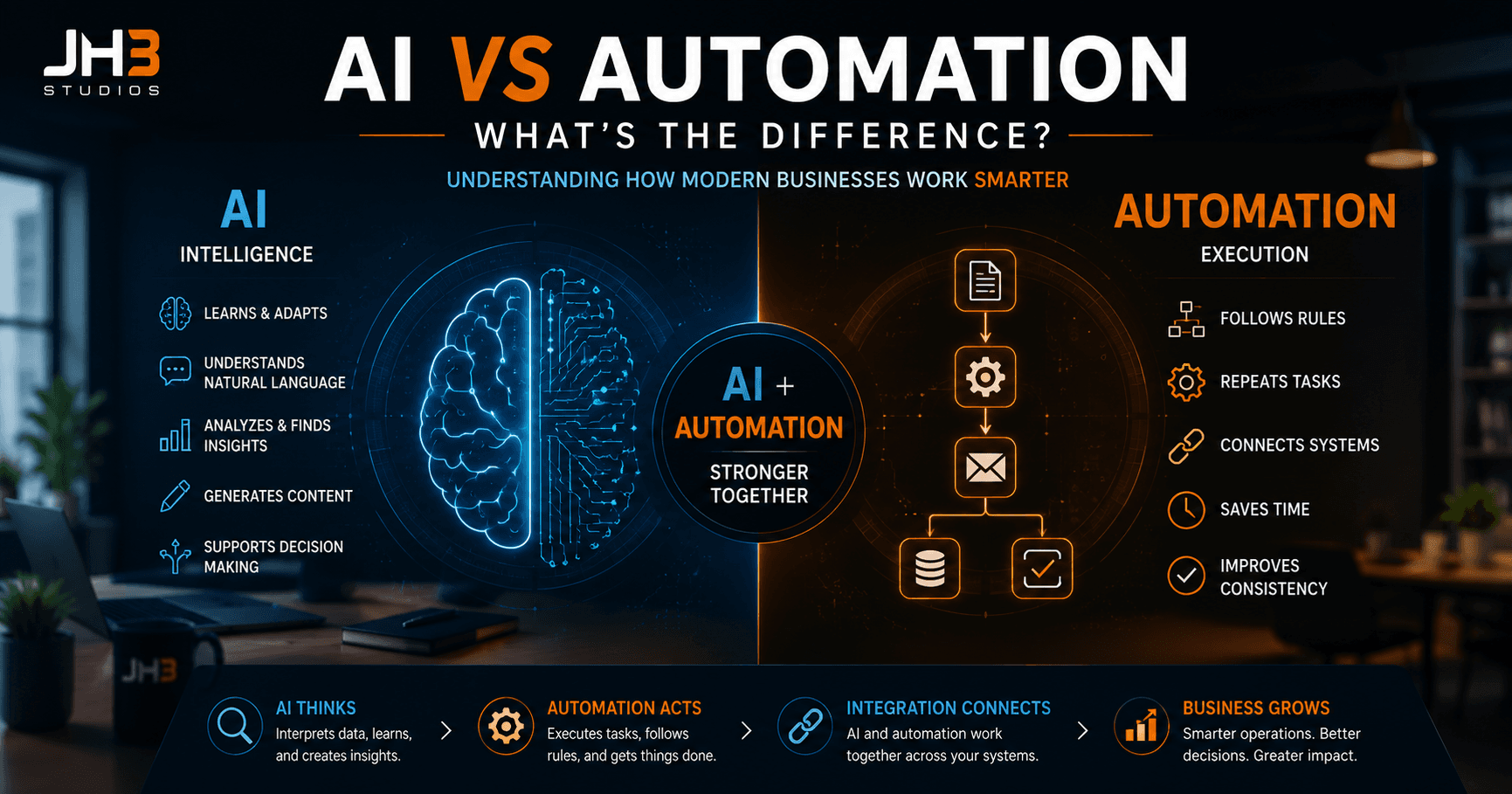
At a practical level, automation is centered around execution and consistency. AI is centered around interpretation, analysis, pattern recognition, and decision support.
Modern businesses generate the greatest value when the two work together.
That combination is where operational systems begin becoming more scalable, connected, and operationally intelligent.
What Automation Actually Is
Automation is fundamentally process driven.
At its core, automation uses predefined rules to execute repetitive tasks without requiring constant manual involvement. The primary goal is not intelligence, but consistency, efficiency, and operational reliability.
Most businesses already rely on automation in some capacity, even if they do not formally describe it that way.
Examples of automation include:
routing invoices for approval,
sending CRM follow-up emails,
assigning tasks after form submissions,
generating scheduled reports,
synchronizing data between systems,
onboarding employees,
triggering reminders and notifications,
managing customer communication sequences,
and handling approval workflows.
These processes do not require advanced reasoning or contextual interpretation. They work because the rules are clearly defined.
If a condition occurs, the system performs an action.
That is automation.
In practical business environments, automation is often one of the fastest ways to reduce operational friction because many organizations still depend heavily on repetitive administrative coordination. Teams manually transfer information between systems, recreate reports, update spreadsheets, forward emails, manage reminders, and maintain workflows that could often be standardized through more structured systems.
Automation reduces that burden.
More importantly, it creates operational consistency.
Processes become repeatable. Tasks become less dependent on individual memory. Workflows become easier to scale and monitor. Visibility improves because actions occur through structured systems instead of fragmented manual coordination.
This is one reason operational clarity matters before businesses aggressively pursue AI initiatives. Organizations with inconsistent workflows often struggle to automate effectively because the underlying process itself lacks structure.
You cannot automate operational chaos efficiently.
What AI Actually Is
Artificial intelligence addresses a different category of operational challenge.
While automation follows predefined rules, AI works with interpretation, context, language, analysis, pattern recognition, and decision support. AI is designed to process information that is less structured and less predictable.
For example, AI can:
summarize meetings,
analyze customer sentiment,
draft content,
answer questions,
classify support tickets,
identify operational trends,
extract information from documents,
support forecasting,
organize internal knowledge,
and generate recommendations based on large volumes of information.
Unlike traditional automation, AI introduces adaptability.
The system is not simply following a fixed sequence of rules. Instead, it is interpreting inputs and generating outputs based on context, probabilities, and learned patterns.
That distinction is important.
A traditional automation workflow may send every customer inquiry into the same queue.
An AI-assisted workflow may first evaluate the message, determine urgency or sentiment, classify the issue type, and dynamically route the request based on context.
That is not just execution.
That is interpretation integrated into operational workflows.
This is also where many businesses begin misunderstanding AI.
AI is not a universal solution that automatically fixes operational inefficiencies. It still depends heavily on good systems, structured information, operational clarity, and thoughtful implementation. AI can improve information handling and support decision-making, but it still requires human oversight, governance, and operational context.
Businesses that approach AI realistically often create significantly more long-term value from it.
The Biggest Misconception Businesses Have
One of the most common misconceptions businesses have is believing AI alone will solve their operational inefficiencies.
In reality, AI often amplifies existing operational problems instead of correcting them.
If an organization has disconnected systems, inconsistent workflows, weak documentation, unclear ownership, poor communication, or unreliable data, AI does not automatically resolve those issues. In many cases, those weaknesses become more visible because AI systems rely heavily on structure and context to function effectively.
This is why operational maturity matters.
Many businesses focus heavily on finding "the right AI tool" while overlooking the operational environment it is entering, treating AI as a shortcut instead of a support layer for stronger operational systems.
If workflows lack structure, automation becomes difficult.
If information is disorganized, AI outputs become inconsistent.
If teams lack visibility into operational processes, additional technology may increase complexity instead of reducing it.
This is one reason many organizations struggle with implementation despite investing heavily in modern tools.
The technology itself is often not the primary problem.
The operational foundation is.
Strong AI and automation systems typically emerge from organizations that understand:
how work moves throughout the business,
where bottlenecks exist,
which repetitive tasks consume unnecessary time,
how communication flows between teams,
where information breaks down,
and what operational friction is slowing the organization down.
Without that visibility, businesses often end up layering technology onto broken processes instead of improving the processes themselves.
Where AI and Automation Work Together
The real value of modern operational systems emerges when AI and automation begin working together. This is where businesses move beyond isolated tools and begin building connected operational workflows.
For example:
AI may summarize incoming customer support tickets while automation routes those tickets to the appropriate department.
AI may draft operational reports while automation distributes those reports to leadership teams on a schedule.
AI may analyze incoming emails for urgency or sentiment while automation creates follow-up tasks inside a CRM.
AI may extract invoice information from documents while automation updates accounting systems and initiates approval workflows.
In these scenarios, AI handles interpretation while automation handles execution. Together, they create significantly more operational leverage than either system independently.
This is where AI becomes less about hype and more about practical operational improvement.
This is also where operational intelligence becomes increasingly important.
Operational intelligence is not simply about adding more technology. it is about building systems where information flows more effectively, workflows become more connected, and businesses gain greater visibility into how operations actually function.
Many organizations still spend significant amounts of time manually coordinating information across disconnected systems. AI and automation together can reduce much of that operational friction when implemented intentionally and strategically.
But Implementation still matters more than hype.
Businesses generate the greatest value when these systems are introduced around real operational problems rather than deployed simply because the technology is trending.
Why Businesses Should Start with Operational Problems First
One of the biggest mistakes businesses make with AI and automation is starting from the technology implementation instead of the operational problem.
The first questions should not be: "What AI Tool should we buy?"
The better questions are:
Where are we losing time?
What repetitive work creates unnecessary operational strain?
Where does communication break down?
What workflows create bottlenecks?
What information is difficult to access?
What processes rely too heavily on manual coordination?
Where does operational visibility break down?
When businesses begin with those questions, technology decisions become significantly clearer.
Sometimes the right solution is automation.
Sometimes it is AI.
Sometimes it is workflow redesign.
And sometimes it is improving documentation, communication, or process clarity before introducing additional technology at all.
Operational thinking matters because most businesses do not suffer from a lack of tools. most organizations already have too many disconnected systems. The larger issue is often a lack of alignment, visibility, integration, or operational structure between those systems.
Technology should support operations, not complicate them further.
This is one reason businesses that approach modernization strategically often outperforms businesses that aggressively chase every new platform or trend.
They focus on solving operational problems first.
The Future of Modern Business Operations
The future of business is not AI replacing entire organizaitons.
The future is businesses becoming more operationally intelligent.
That means organizations becoming:
more connected,
more visible,
more scalable,
more efficient,
and less dependent on repetitive manual coordination.
AI and automation are both important parts of that evolution, but neither replaces the importance of operational discipline, process ownership, workflow clarity, leadership, or strategic thinking.
Businesses will still require strong systems.
They will still require accountability.
They will still require operational structure.
They will still require people capable of understanding how workflows, systems, and information move across the organization.
The businesses that benefit most from AI and automation over the next decade will likely be the organizations that combine modern technology with strong operational infrastructure.
Not because they adopted technology the fastest, but because they implemented it intentionally.
That distinction will matter more and more as businesses continue modernizing their operations.
Final Thoughts
AI and automation are complementary technologies, but they are not interchangeable.
Automation improves consistency by executing repetitive workflows through predefined processes. AI improves adaptability by helping businesses interpret information, identify patterns, and support decision-making.
Modern organizations benefit most when both technologies support strong operational systems rather than attempting to replace them.
The businesses likely to generate the greatest long-term value are not necessarily the ones chasing the newest tools or trends. They are the ones building connected systems, improving operational visibility, reducing friction, and modernizing intentionally over time.
Because in the end, operational maturity matters far more than hype.