
What AI Actually Means for Modern Businesses
Why operational clarity, systems, and intentional implementation matter more than AI hype.

Artificial intelligence has quickly become one of the most talked-about topics in business over the past few years. Every day, there seems to be a new platform, tool, or consultant promising AI-powered workflows, instant productivity gains, automated decision-making, or some version of "business transformation."
For a lot of business owners and teams, the amount of noise around AI has become difficult to sort through.
Some companies are rushing to adopt every tool they can find because they do not want to fall behind; while others are avoiding AI altogether because it feels too technical, too expensive, or too disruptive. In both cases, the problem is often the same: AI is being treated as the starting point instead of the support system.
The reality is much more practical.
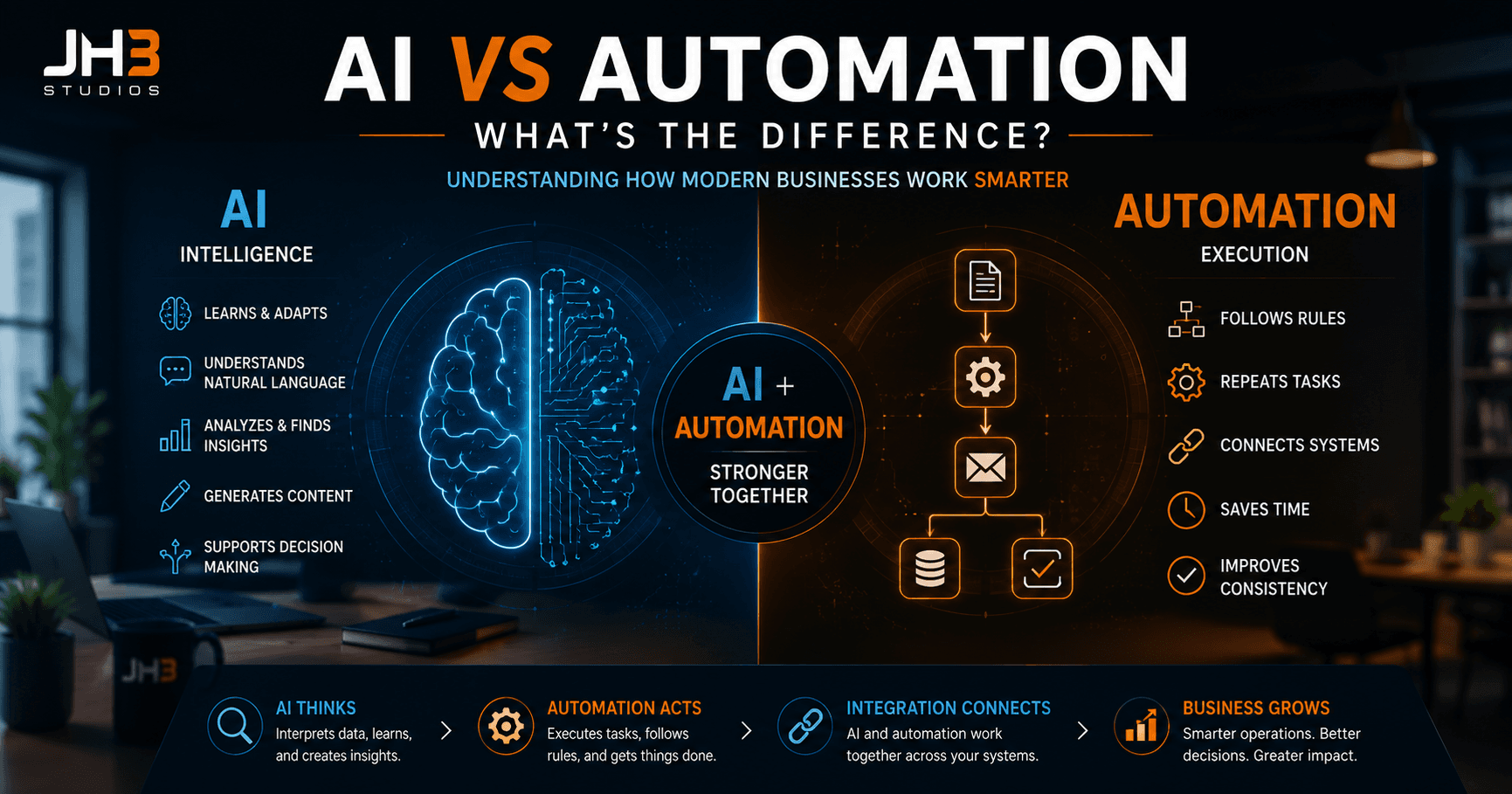
Artificial intelligence is not magic, and it is not a replacement for strong business operations. It is a tool. A powerful one, but still a tool. Many businesses also confuse AI with automation, despite the two serving very different operational purposes. When used intentionally, AI can help organizations reduce repetitive work, organize information, improve visibility, support decision-making, and scale processes more effectively.
But the businesses that will benefit most from AI are not automatically the ones using the most advanced tools. They are the ones that understand their workflows, bottlenecks, customer experience, data, and internal processes well enough to know where AI actually fits.
That distinction really matters.
AI Is Not Replacing Business Fundamentals
One of the biggest misconceptions around AI is the idea that it removes the need for structure, documentation, process clarity, or human judgment.
In practice, AI usually amplifies what already exists inside a business.
If the business has disorganized workflows, inconsistent communication, poor documentation, disconnected systems, or unclear ownership, adding AI does not automatically solve those issues. In many cases, it makes them more visible. Sometimes it even creates more confusion because the tool is being placed on top of a process that was already unstable.
This is why I tend to look at AI from an operations-first perspective.
Before asking what AI can automate, it helps to understand how the work currently moves through the business. Where does information get stuck? Where are people doing the same task over and over? Where are reports being manually recreated? Where are customers waiting because internal systems are not connected? Where does leadership lack visibility?
AI works best when it is applied to real operational problems. In many cases, solving those operational problems involves understanding when a business needs automation, AI, or a combination of both.
For most businesses, that means using AI to support practical improvements like reducing manual administrative work, improving reporting, organizing internal knowledge, streamlining customer communication, and helping employees spend more time on work that actually requires judgment.
That is a much more realistic path than chasing whatever tool is trending this week.
The Real Value of AI in Business
For most organizations, the immediate value of AI is not replacing entire departments. The real value is improving efficiency, consistency, and decision support.
Modern businesses create and manage a large amount of information every day. Emails, spreadsheets, customer messages, reports, meeting notes, project updates, operational data, SOPs, and internal documentation all create noise. The challenge is not just having information. The challenge is turning that information into something usable.
This is where AI can be genuinely helpful.
This is also where businesses often begin confusing AI capabilities with traditional automation workflows.
AI can summarize meetings, draft documentation, organize internal knowledge, support customer response workflows, analyze trends, assist with reporting, and help teams work through ideas faster. It can reduce some of the friction that slows down day-to-day operations.
But none of that eliminates the need for people.
AI still needs direction, context, review, and oversight. It can support better work, but it should not be treated as the final authority. The businesses that use AI well will be the ones that understand how to combine automation with human judgment instead of pretending one replaces the other.
This is where AI becomes useful in a real business environment.
Businesses Should Focus on Operational Intelligence
One of the biggest opportunities AI creates is the ability for businesses to become more operationally intelligent.
To me, operational intelligence is about having better visibility into how the business actually runs. It means having clearer workflows, stronger reporting, better communication, cleaner data, and systems that help people make decisions instead of forcing them to constantly chase information.
A lot of business still operate reactively. Teams move information manually from one system to another. Reports are rebuilt every week or every month. Customer information lives in multiple places. Internal knowledge is scattered across emails, chats, documents, and individual employees. Leadership may know something is inefficient but not have a clear view of where the breakdown is actually happening.
AI can help reduce that friction, but only when the business starts with the right questions.
The starting point shouldn't be "What AI tool should we use?"
The better starting point is:
Where are we losing time?
What tasks are repetitive?
Where does communication break down?
What information is difficult to access?
What processes create bottlenecks?
What work creates unnecessary strain on the team?
When businesses start from those questions, AI becomes much easier to apply in a useful way. It becomes part of a broader system instead of a disconnected experiment.
The Businesses That Will Benefit Most from AI
The businesses that benefit most from AI will not necessarily be the ones that adopt it the fastest. They will be the ones that combine strong operations, clear systems, quality data, modern workflows, and intentional automation.
AI does not reduce the importance of leadership, communication, strategy, or operational discipline. If anything, it increases the importance of those things. A business still needs to understand what it is trying to improve, what outcomes matter, and how work should move from one step to the next.
Technology alone does not create a scalable business.
Well-designed systems supported by the right technology do.
That is the difference between using AI as a shortcut and using AI as part of a practical business improvement strategy.
Final Thoughts
Artificial intelligence is not a shortcut for fixing broken operations.
It is a tool that can help well-structured businesses move faster, reduce repetitive work, improve visibility, and make better decisions over time.
The businesses that approach AI with clarity, operational awareness, and realistic expectations will likely see the most long-term value. Not because they are chasing every new tool, but because they understand where AI fits into the larger picture.
The goal should not be to look more advanced.
Businesses often see significantly better results when they first understand the distinction between AI systems and operational automation before implementing either.
Therefore, the goal should be to build smarter, more connected, and more operationally intelligent businesses.